














If you’re planning to retire before age 59½, you’ve probably wondered how you’ll access your retirement savings without paying a 10% early withdrawal penalty.
One strategy that may help is the Rule of 55. This IRS provision allows some workers to withdraw money from their employer-sponsored retirement plan before age 59½ without paying the additional 10% penalty.
While the Rule of 55 can be a valuable retirement planning tool, it doesn’t apply to everyone. Understanding how it works, and its limitations, can help you decide whether it’s part of your retirement income strategy.
What Is the Rule of 55?
The Rule of 55 is an IRS exception that allows eligible workers to take penalty-free withdrawals from their current employer’s 401(k) or 403(b) after leaving their job in or after the year they turn 55.
Normally, withdrawals made before age 59½ are subject to a 10% early withdrawal penalty, in addition to ordinary income taxes. The Rule of 55 removes the penalty, but not the taxes.
For many early retirees, this can provide flexibility during the years before Social Security or Medicare begins.
How Does the Rule of 55 Work?
To qualify, you generally must:
- Leave your employer during or after the calendar year you turn 55
- Have money in your current employer’s retirement plan
- Withdraw funds directly from that employer-sponsored plan
For example:
Sarah turns 55 in April 2026 and retires from her employer in October 2026. She has $900,000 in her company’s 401(k). Because she left employment during the year she turned 55, she can begin taking withdrawals without paying the 10% early withdrawal penalty.
She will still owe federal and, where applicable, state income taxes on traditional 401(k) withdrawals.
Who Qualifies for the Rule of 55?
You may qualify if you:
- Leave your employer voluntarily or involuntarily
- Retire, resign, or are laid off
- Separate from service during or after the year you turn 55
- Have assets remaining in your employer’s retirement plan
Certain public safety employees may qualify beginning at age 50 under separate IRS rules.
Who Does NOT Qualify?
The Rule of 55 doesn’t apply in every situation.
You generally cannot use it if:
- You leave your employer before the year you turn 55.
- You already rolled your 401(k) into an IRA.
- You’re trying to withdraw from an old employer’s 401(k) after rolling it elsewhere.
- You’re taking money from a Traditional or Roth IRA.
Many people unknowingly eliminate their eligibility by immediately rolling their 401(k) into an IRA after retirement.
Before completing a rollover, it’s worth understanding how it could affect your withdrawal options.
Rule of 55 vs. 72(t)
Both the Rule of 55 and 72(t) allow certain retirees to access retirement savings before age 59½ without the 10% early withdrawal penalty. However, they have different eligibility requirements and withdrawal rules. The comparison below highlights the key differences.
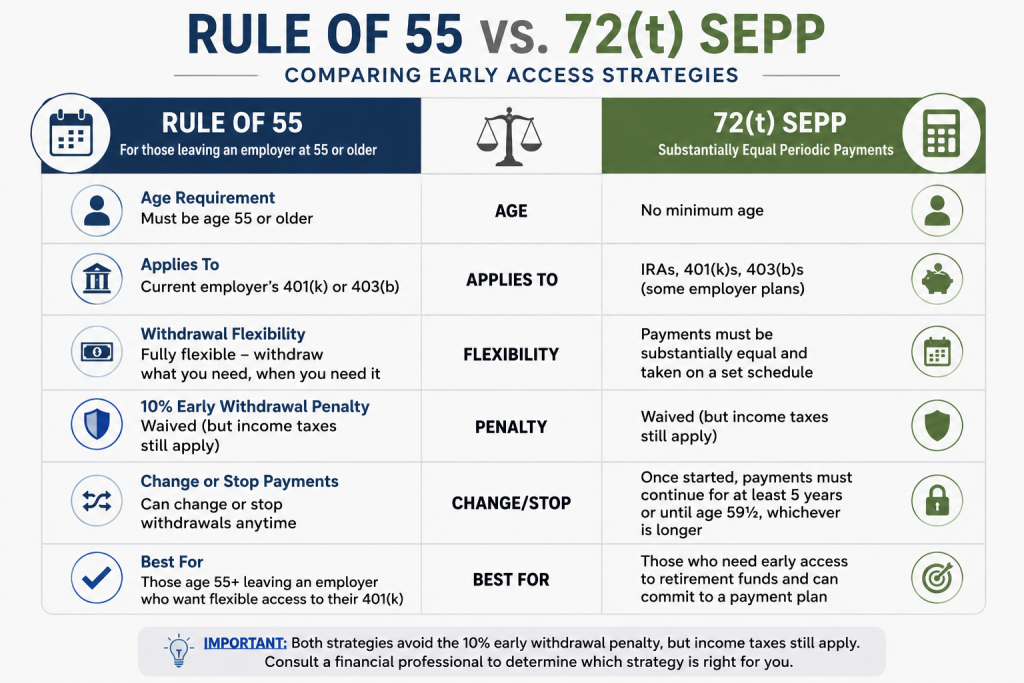
Pros of the Rule of 55
Avoid the 10% Penalty
The biggest benefit is avoiding the additional IRS penalty.
Bridge the Gap Until Social Security
Many people retire before claiming Social Security. The Rule of 55 can help provide income during those years.
Greater Flexibility
Unlike 72(t) withdrawals, there is no required payment schedule.
You can generally withdraw only what you need.
Potential Drawbacks
You Still Pay Income Taxes
Although the penalty disappears, withdrawals from a traditional 401(k) remain taxable as ordinary income.
Large withdrawals could push you into a higher tax bracket.
It Only Applies to Your Current Employer’s Plan
Money sitting in previous employers’ retirement plans generally doesn’t qualify unless it has been consolidated into your current employer’s plan before separation (if the plan allows it).
It May Affect Long-Term Retirement Income
Taking significant withdrawals early could reduce future portfolio growth and increase the risk of running out of money later in retirement.
Common Rule of 55 Mistakes
Some of the most common mistakes include:
- Rolling a 401(k) into an IRA too soon.
- Assuming all retirement accounts qualify.
- Taking larger withdrawals than necessary.
- Forgetting about income taxes.
- Not coordinating withdrawals with Social Security and Medicare planning.
- Ignoring Required Minimum Distribution (RMD) planning later in retirement.
Working with a financial professional can help ensure your withdrawal strategy fits into your broader retirement plan.
FAQs
Yes. The separation doesn’t have to be retirement. Resigning, being laid off, or leaving voluntarily may all qualify, provided you leave during or after the year you turn 55.
No.
It only waives the 10% early withdrawal penalty. Traditional retirement account withdrawals are generally still taxable.
Yes.
The Rule of 55 generally applies based on leaving the employer that sponsors the retirement plan. Many people retire from one employer and later work elsewhere.
Potentially yes, if the Roth account is within your employer-sponsored retirement plan and you otherwise meet the eligibility requirements. However, the tax treatment of earnings can differ depending on whether the withdrawal is qualified.
It depends on your overall retirement plan.
While avoiding a 10% penalty sounds appealing, early withdrawals can affect taxes, future investment growth, Medicare premiums, Social Security timing, and long-term retirement security.
The best strategy depends on your income needs, other assets, and long-term financial goals.