









Many retirees enjoy managing their own investments. With low-cost index funds, online brokerages, and endless financial information available, it’s easier than ever to build and maintain a portfolio without hiring an advisor.
But retirement introduces a different set of challenges than simply growing your investments. Once you’re relying on your portfolio to generate income, tax planning, healthcare costs, estate planning, and withdrawal strategies all become just as important as investment returns.
Recently, we met with a retired Connecticut couple who had successfully managed their own investments for years. Their situation highlights an important question many self directed investors eventually ask:
“Am I still doing everything I can, or is there value in getting a second opinion?”
Self-Directed Investing Can Work—Until Retirement Changes the Equation
Throughout their careers, this couple accumulated approximately $4.2 million in assets through disciplined saving, investing primarily in index funds, brokerage accounts, retirement accounts, company stock, and cash reserves.
They weren’t struggling financially.
In fact, they had done many things right:
- A paid-off home
- Significant retirement savings
- Low debt
- Diversified investment accounts
- Cash reserves for market downturns
- A moderate investment approach they understood
Like many self-directed investors, they were comfortable making investment decisions on their own.
However, retirement brought entirely new questions.
Retirement Isn’t Just About Investment Performance
Once paychecks stop, retirees begin making decisions that can impact their finances for decades.
Some of the biggest questions include:
- When should you claim Social Security?
- Should you convert money to a Roth IRA?
- How much should you withdraw each year?
- How do you minimize taxes on retirement income?
- What happens if the market declines early in retirement?
- How should pensions and annuities fit into the plan?
- How do you pass assets efficiently to your children?
These decisions often have a larger financial impact than choosing between two mutual funds.
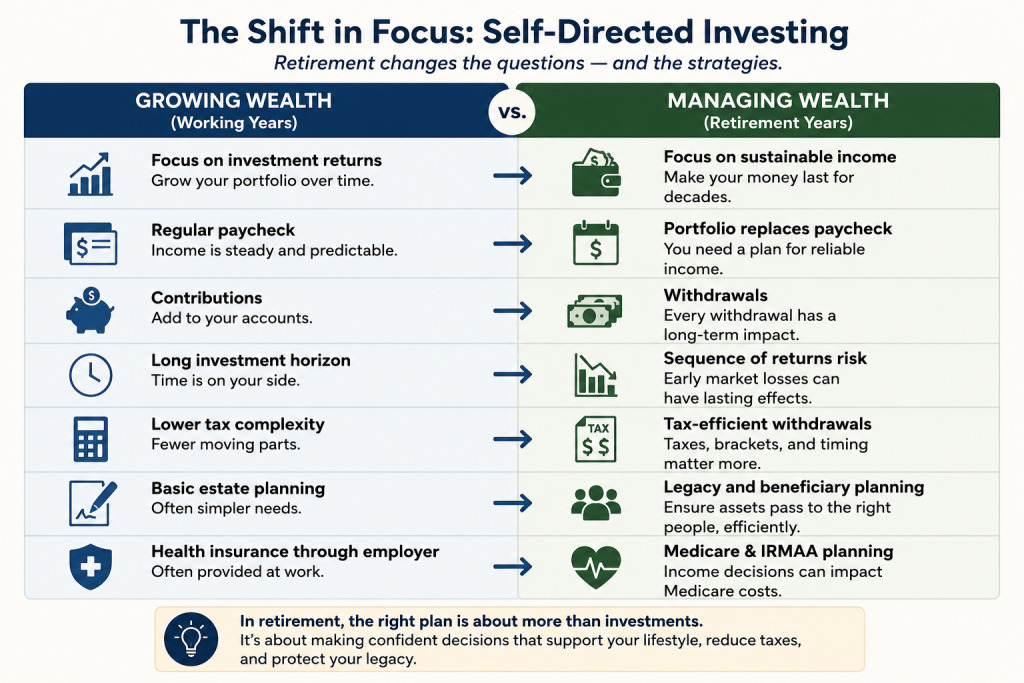
The Hidden Tax Decisions Self-Directed Investors Face
One of this couple’s biggest concerns wasn’t investment performance.
It was taxes.
They wanted to understand:
- Whether Roth conversions made sense
- How much they could convert without moving into a higher tax bracket
- How Medicare’s Income-Related Monthly Adjustment Amount (IRMAA) could affect their premiums
- How to reduce unnecessary taxes on brokerage investments
Many retirees discover that retirement planning is largely tax planning.
Making the wrong withdrawal from the wrong account at the wrong time could increase:
- Federal income taxes
- State taxes
- Medicare premiums
- Taxes on Social Security benefits
Even investors who feel confident managing portfolios often seek guidance on creating a more tax-efficient retirement income strategy.
Learn more about Roth IRA conversions and retirement tax planning to understand how conversions may fit into a long-term strategy.
Investment Management Is Only One Piece of Retirement Planning
This couple also wanted guidance on several topics unrelated to choosing investments.
These included:
Estate Planning
After a recent death in the family, they realized their estate documents were outdated.
They wanted to evaluate:
- Updating their will
- Creating powers of attorney
- Whether a revocable trust would make sense
- Passing assets efficiently to their two adult children
Estate planning becomes increasingly important as retirement progresses, especially when significant assets are involved.
You may also want to read our guide on Estate Planning in Retirement.
Social Security Timing
Neither spouse had started collecting Social Security.
Instead of simply claiming at age 65 or 66, they wanted to understand how delaying benefits could impact:
- Lifetime income
- Survivor benefits
- Taxes
- Medicare premiums
For many couples, the decision of when to claim Social Security can be worth tens of thousands of dollars over retirement.
Read more in our article on When Should You Claim Social Security?.
Managing Retirement Income
Their monthly spending included both essential living expenses and discretionary spending like travel and dining out.
Rather than simply withdrawing a fixed percentage every year, they wanted to evaluate:
- Sustainable withdrawal strategies
- Cash reserves during market downturns
- Pension income
- Future annuity decisions
- Long-term income stability
Creating a retirement paycheck often requires coordinating multiple income sources instead of relying on one investment account.
Why Many Self-Directed Investors Seek a Second Opinion
One of the biggest misconceptions about financial planning is that hiring an advisor means giving up control.
Many self-directed investors simply want another perspective.
A retirement review can help identify opportunities that may otherwise be overlooked, including:
- Tax-efficient withdrawal sequencing
- Roth conversion opportunities
- Portfolio concentration risks
- Social Security optimization
- Medicare planning
- Estate planning gaps
- Beneficiary reviews
- Long-term care considerations
For investors who enjoy managing their own money, professional guidance doesn’t necessarily replace self directed investing—it can complement it.
Is Self-Directed Investing Right for Your Retirement?
There isn’t a single right answer.
Some retirees continue successfully managing their own portfolios for decades.
Others find that retirement’s growing complexity makes professional guidance worthwhile, even if they continue making many investment decisions themselves.
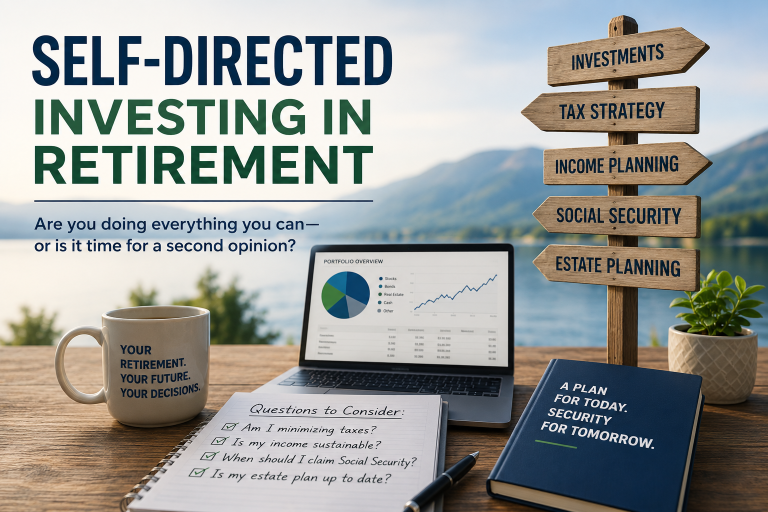
You may benefit from a second opinion if you’re asking questions like:
- Am I withdrawing from the right accounts?
- Am I paying more taxes than necessary?
- Should I convert part of my IRA to a Roth?
- How can I reduce future Medicare premiums?
- Is my estate plan current?
- Am I invested appropriately for retirement income?
These are planning questions rather than investment questions—and they often have a lasting impact on retirement success.