













Many people wonder whether they’re financially ahead, behind, or somewhere in the middle.
One of the most common ways individuals measure financial progress is by looking at their net worth. But what net worth is actually considered wealthy in 2026?
The answer depends on who you ask.
For some, wealth means having enough money to retire comfortably without financial stress. For others, it means achieving financial independence, leaving a legacy for future generations, or simply having the freedom to make choices without worrying about money.
While there is no universal definition of wealth, understanding net worth benchmarks can provide valuable context as you evaluate your own financial progress.
What Is Net Worth?
Net worth is the difference between what you own and what you owe.
The formula is simple:
Net Worth = Assets – Liabilities
Assets may include:
- Retirement accounts
- Investment accounts
- Real estate
- Cash and savings
- Business interests
Liabilities may include:
- Mortgages
- Student loans
- Credit card debt
- Auto loans
- Other outstanding obligations
Your net worth provides a snapshot of your overall financial health and can be a useful tool for tracking progress over time.
What Net Worth Is Considered Wealthy?
There is no official number that defines wealth. However, many financial professionals consider the following benchmarks:
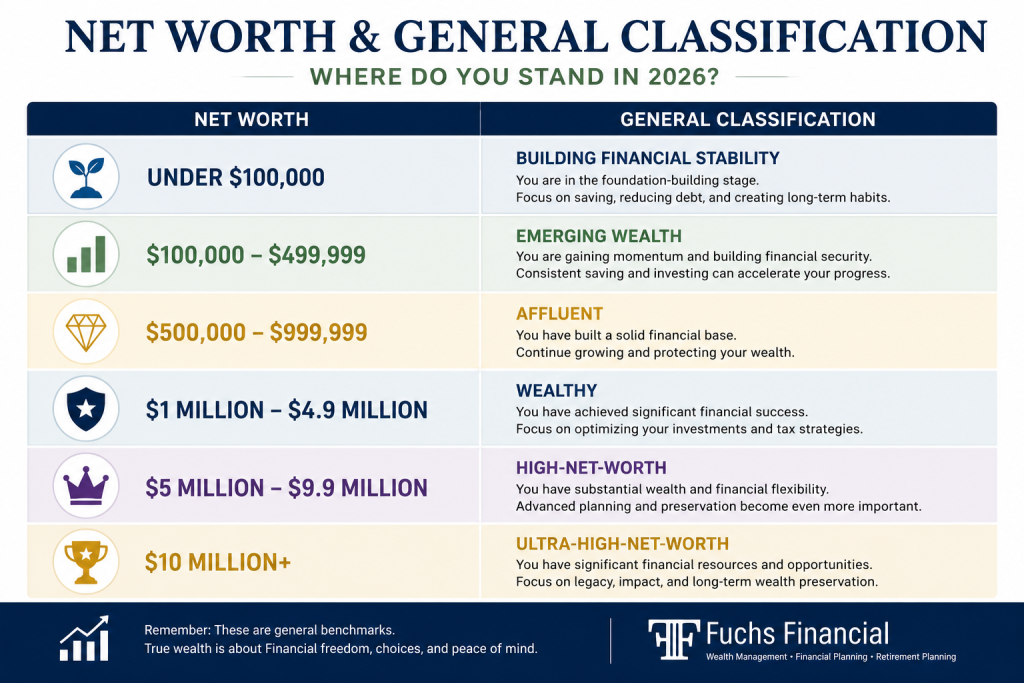
While these categories provide general guidance, it’s important to remember that wealth is highly personal. Someone living comfortably with a $1 million net worth may feel wealthier than someone with significantly more assets but substantial financial obligations.
Net Worth by Age: Are You On Track?
Comparing yourself to others isn’t always productive, but age-based benchmarks can provide perspective.
Age 30
Many individuals are still paying off student loans, purchasing homes, and building careers.
A net worth between $50,000 and $250,000 is often considered a strong foundation by age 30.
Age 40
By this stage, many professionals are entering their peak earning years.
A net worth between $250,000 and $750,000 may indicate solid financial progress.
Age 50
As retirement planning becomes increasingly important, many households begin focusing more aggressively on wealth accumulation.
A net worth of $750,000 to $2 million often reflects strong retirement preparation
Age 60
For individuals approaching retirement, net worth becomes less about accumulation and more about sustainability.
Many financially secure retirees have a net worth exceeding $1 million, although retirement readiness ultimately depends on income, spending, taxes, and healthcare costs- not simply account balances.
Why Net Worth Doesn’t Tell the Whole Story
While net worth can be a useful benchmark, it doesn’t necessarily determine whether someone is financially secure.
For example:
- A retiree with a pension may require less accumulated wealth.
- A business owner may have significant assets tied up in their company.
- A household with substantial real estate equity may have a high net worth but limited liquidity.
That’s why comprehensive financial planning involves much more than tracking a single number.
Important considerations include:
- Retirement income planning
- Tax efficiency
- Investment strategy
- Estate planning
- Risk management
- Healthcare planning
Characteristics of Wealthy Individuals
While net worth varies significantly, many wealthy individuals share similar habits:
They Save Consistently
Building wealth often involves decades of disciplined saving and investing.
They Avoid Lifestyle Inflation
Many affluent households increase savings as income rises rather than increasing spending at the same pace.
They Think Long Term
Wealth accumulation typically rewards patience and consistency rather than short-term speculation.
They Have a Plan
Successful investors often work from a comprehensive strategy that coordinates investments, taxes, retirement planning, and legacy goals.
Should You Focus on Net Worth or Retirement Readiness?
For most individuals, retirement readiness is ultimately more important than net worth alone.
A household with a lower net worth but strong retirement income sources may be better positioned than a household with significant assets but no clear income strategy.
Questions worth asking include:
- Will my assets generate sufficient retirement income?
- How will taxes impact my retirement?
- When should I claim Social Security?
- How much risk should I take with my investments?
- What legacy do I want to leave behind?
Answering these questions can provide a more complete picture of financial success than any net worth benchmark alone.
The Bottom Line
While many people consider a net worth of $1 million or more to be wealthy, true financial success depends on much more than a number.
Net worth can serve as a valuable benchmark, but long-term financial security often comes from disciplined saving, thoughtful planning, tax efficiency, and a clear understanding of your goals.
Whether you’re building wealth, preparing for retirement, or evaluating your financial progress, focusing on the bigger picture can help you make more informed decisions and create a stronger financial future.
FAQs
For many households, yes. A net worth of $1 million is often viewed as a significant financial milestone. However, factors such as location, lifestyle, retirement goals, and spending needs can influence whether someone feels financially secure.
Definitions vary, but many financial studies classify households with net worths exceeding $1 million as affluent or upper class. In higher-cost areas, the threshold may be considerably higher.
Millionaire households represent a relatively small percentage of the population, although the number has increased significantly over the past several decades due to rising home values, retirement account growth, and business ownership.
Income helps build wealth, but net worth provides a broader view of overall financial health. Two households with identical incomes can have dramatically different net worths depending on spending, saving, investing, and debt management habits.
“The following link/content may include information and statistical data obtained from and/or prepared by third-party sources that Foundations Investment Advisors, LLC (“Foundations”), deems reliable but in no way guarantees its accuracy or completeness. Foundations had no involvement in the creation of the content and did not make any revisions to such content. All such third-party information and statistical data contained herein is subject to change without notice and may not reflect the views or opinions of Foundations. Nothing herein constitutes investment, legal, or tax advice, or a recommendation that any security, portfolio of securities, or investment strategy is suitable for any specific person. Personal investment advice can only be rendered after the engagement of Foundations, execution of required documentation, and receipt of required disclosures. All investments involve risk, and past performance is no guarantee of future results.”