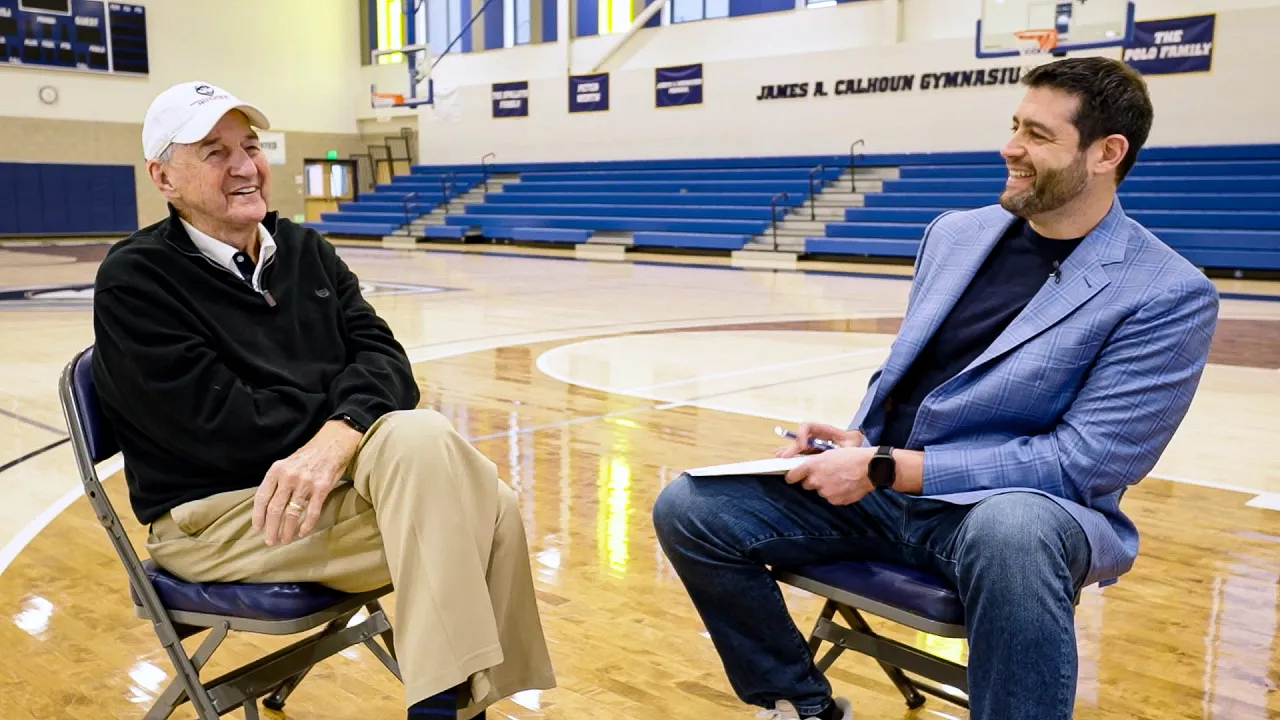
Ben Fuchs: Hello, and welcome to an extra special edition of How to Retire. Obviously, we’re not in our normal studio, but here in a basketball gymnasium. This show focuses on making retirement work for every individual, and that almost never means walking away from something you love entirely. Few understand the art of that transition quite like Jim Calhoun. After building UConn into a national champion three times over, after decades of pressure, Hall of Fame inductions, expectations, and relentless competition, he faced the question every leader eventually faces: Who are you when the whistle stops? Today, we’re talking about legacy, leadership, and what it really means to walk away. Coach Calhoun, a true Connecticut legend — welcome. Jim Calhoun: Thank you. And I think you said it best. It’s hard to walk away, and it’s hard to find the time to walk away. You tell yourself, “Maybe next year. Maybe after the season.” There are all kinds of different rationales, but they all come down to this: I’m going to stop doing something that I’m pretty good at — and secondly, something I love. That is the most difficult aspect. It’s funny — I don’t have a show like you do about retirement — but a lot of people say, “I can’t wait to have so much more time.” I say, “Pretty soon, you won’t,” because you won’t be doing what you care about and what you’re really good at. Ben Fuchs: I have a lot of clients that I work with, and they all talk about retirement like it’s this big goal — “I can’t wait to do it.” Then they get there, and when they can actually make the decision and walk away, they don’t want to. They’ve worked so hard to get where they’ve gotten. They’ve gotten to the top of their field, and then the idea of losing all of that, I think, is brutal. What was it like for you — not the decision to retire, but after, when you were actually retired? Jim Calhoun: Well, I was no longer “coach.” Everybody calls me coach, and I like that terminology. John Wooden had a book called They Call Me Coach, and John Wooden was an idol of mine. I actually got a chance to visit his house after his wife Nell died. I spent about two and a half hours in his condo talking basketball. He was an incredibly brilliant man and a great coach. But it is not easy to just walk away. Walking away cold turkey is really, really difficult — or at least I found it difficult. Ben Fuchs: I would assume the call to come back starts almost immediately, right? How hard was that to resist? Jim Calhoun: Some people called and said, “We can make it better for you.” I said, “No, you can’t, because you can’t change me.” It’s not just about whether a situation has this or that. It’s about how I fit into what you’re doing. I try to create an atmosphere — or culture, though I hate that word because it’s overused — at the schools I’m at, with the players I have, and with the traditions I can go back on. If some kid starts telling me about a jump shot, I say, “Let’s see — Ray Allen and Rip Hamilton. I talked to them, and they came here too. You might want to listen to me.” Ben Fuchs: That’s after you had established yourself. But what about when you first came to UConn, when you were practicing in a barn, sharing the gym with other sports? How did you get the buy-in? What did it take to build that consistency? Jim Calhoun: Show up every day and try to do the common uncommonly well. That’s how our culture was built — and again, I hate the word “culture,” but it’s the way we did things. I felt that basketball is sometimes made too complex. It’s a simple game: stop them from putting the ball in the basket, and put the ball in the basket yourself. How you get there is through repetition and discipline. I went to grad school for psychology, so maybe that shows. Sometimes it would take me two hours to put together an hour-and-a-half practice, because I wanted to make sure the things we did every day were right. If you do too much, you don’t do anything really well. So we tried to focus on five or six basic things and do them exceptionally well, while making adjustments based on the personnel we had. Ben Fuchs: One of the things I loved reading in your book was how you would show up by yourself in a taxi, compared to other coaches arriving in limousines with entourages. Why? Jim Calhoun: Because to players — especially before the NIL era — the greatest thing for them came down to one thing: minutes. There are 200 minutes in a game, and it’s my job to divide them up. A lot of people don’t realize that if I take those minutes away — or don’t give you the minutes you want — it affects your career, your psychology, your confidence, everything. I’ve had moms, dads, and players ask, “He only played two minutes last night.” My answer was: that’s what he deserved. Not because he can’t become a good player, or because he doesn’t have a future, but because right now, that’s what he earned. I’d say, “You have 136 tryouts.” That’s how many practices we had. During those practices, I’m not sleeping — I’m watching you compete against your teammates. Every day you step into that gym, you’re trying out. If you’re dominating Ray Allen or Emeka Okafor or whoever it may be, I’d be a fool not to use you. So I’m not saying you’re failing, but you may be getting beat by an exceptional teammate. And minutes are going to be divided based on performance. Ben Fuchs: It was interesting to me — the transition from coaching players to coaching coaches, and then it seemed like you were also coaching fathers. How has that transition been? Jim Calhoun: That transition isn’t quite as difficult. It’s still a 24-hour-a-day process. You can get a phone call at 8:00 at night from someone bringing up something that happened two days ago — which, to me, is ancient history. But I think the most difficult thing when I walked away — and you mentioned this before — is that people talk about retirement like it’s this golden era. Not quite so golden, because you’re giving up something you love, something you do pretty well, and something that gives you great satisfaction. The relationships with players — that’s what I pride myself on. Ben Fuchs: It’s interesting, because we talk about walking away and walking away cold turkey, but the foreword for your book was written by Dan Hurley. He talked about wanting to commiserate with a fellow coach, and he came to you. You gave him some pretty direct advice, if I recall correctly. Jim Calhoun: I think it was a little more than that. I tried to match his words, so we had a pretty direct exchange. I told him, “Maybe they hired the wrong guy.” I didn’t actually think that, of course. But he’s at Connecticut. We had already won championships here. I didn’t want to hear his complaints — I wanted to hear what he was going to do about it. That’s the single most important thing. Everybody talks about retirement like it’s this great thing and all these great things are going to happen. But what about boredom? I’m used to going from one place to another and thriving on that. I thrive on accomplishment — not for the public, but because doing something meaningful makes me feel whole. I retired from UConn and started doing ESPN, calling Big Ten games. It was a great job. I was doing about 40 games a year, getting paid well, and I still had time left on my contract, so life seemed perfect. It was perfect — except I had no stake in the games. I’d leave, and my palms never sweat. I didn’t realize how hard that would be to give up. By the fourth year, I told ESPN, “I’m not going to do it next year.” We had an opening here, and I came back to help Bill Cardarelli, the AD, find a suitable replacement — and it turned out to be me. I knew what I missed. I missed being with the kids. It keeps you young, it keeps you relevant, but more importantly, it gives you great satisfaction. My dad died when I was 15 of a heart attack. My younger brother, who’s now a cardiologist at Mass General, was five. I had five sisters. You can imagine what that did to our family. I had a full scholarship to UMass, but I turned it down because my mother had heart issues, and I worked as a stone cutter for two years. So my path was a little different. Cutting stone, picking up 100-pound markers all day — I put on about 20 pounds of muscle, which was good. But I was also getting angsty. I knew that wasn’t where I wanted to be. Eventually I went back to school, and my mother got healthier, and my older sister was working, so we were able to make that happen. Life builds who you become. I didn’t think I’d love coaching at first. I really didn’t. But over time, I learned the joy of the game and the joy of helping young men who really wanted to get it done. Ben Fuchs: In his semi-retirement, Jim Calhoun has become an author. His third book, More Than a Game, is available on Amazon, in bookstores, and wherever books are sold. This show, as always, is brought to you by Fuchs Financial. Your retirement might not look just like Jim Calhoun’s — it should look like your own. If you need help getting there, give us a call. More with the Connecticut icon after this break. [Commercial Break] Announcer: We know the market is going to get worse from here. This is the biggest monthly decline in 10 years for people’s 401(k)s. My investments are tanking. My retirement isn’t going as planned. I can’t believe I let my kid talk me into buying crypto. What even is that anyway? This was the fourth worst contraction in history. So, how are you two doing? Your financial future doesn’t have to be uncertain. Plan your retirement right. Call now for your own complimentary portfolio review and tax analysis. Ben Fuchs: Welcome back to How to Retire. We are here at the University of Saint Joseph with Jim Calhoun. Honored to have you here, sir. Jim Calhoun: Thank you. Ben Fuchs: Before the break, we were talking about how you grew up and how you got into coaching. I want to talk a little more about how you actually coach. How do you know when to push, when to pull, when to go hard, when to give love? Where does that come from? Jim Calhoun: Well, I could sell you a book. The book is called More Than a Game. Ben Fuchs: I’ve heard of this book. Jim Calhoun: One of my former managers — not players — who won the world championship last year captured it perfectly. He said it was “chaos with purpose.” He had never seen a college practice like that. What we tried to do was emphasize a minimum number of things, but do them exceptionally well. I tried to maximize what everybody did, and then take it one step beyond that. Everybody has more in them than they realize. Let me give you a story. Reggie Lewis — great kid, died at 27, Celtics captain, All-Star. I got him from Dunbar in Baltimore, and he played for me at Northeastern. As a freshman, he came up to me one day in his very soft voice and said, “Coach, can you do me a big favor?” I said, “Sure, Reggie. You’ve been doing great things. What is it?” He said, “Can you not yell at me in front of the fellas?” That bothered him. So if you don’t know what makes a person tick, you may be attacking the wrong thing. For Reggie, that was important. Did I yell at him? Very little. I didn’t have to. He was a great player and a great kid. If you don’t know your players, you’re probably going to be in bad shape, because you’re hitting them right where you shouldn’t be hitting them. You should try to understand what matters to them and help them accordingly. That’s what a leader does. Deron Sheffer came to visit me a short time ago — he lives in Israel now. He always talked about something he noticed: my wife would be sitting next to me on the bus, and when we’d pull up to a gym or a restaurant, the door would open, I’d stand up, and I’d gesture for my wife to go first. He remembered that. The way I treated my wife, my children, my grandchildren — that gave him a blueprint for how to treat somebody. If you know somebody, you can treat them the way they need — not the way you think they need. Ben Fuchs: Is that the secret to 59 years of marriage? Jim Calhoun: It’s 59 years, yes. And statistically, that puts us in a very small percentage of people. A lot of factors can affect that — death, illness, all kinds of things — but Pat and I are not far away from 60. Ben Fuchs: When I was a junior in high school, I spent a semester in Israel — about four months. While I was there, I made the mistake a couple of times of telling people I was from Connecticut, and everyone asked, “Oh, do you know Deron Sheffer?” But how do you recruit a guy from Israel? Jim Calhoun: Part of the secret to success at UConn was that I started recruiting against the best — John Thompson, Lou Carnesecca, P.J. Carlesimo, Rick Pitino, Jim Boeheim. Six of us ended up in the Hall of Fame. It was a heck of a league. At first, I had a tough time getting local kids. They didn’t want to go to the “cow college,” as they called it back then. So I branched out. If I was in Seattle recruiting, I’d say, “Do you like the Big East?” The kid would say yes. I’d ask, “What school do you like?” Maybe he’d say Georgetown. I’d say, “Did Coach Thompson call you this week?” “No.” “Well, how would you like to beat Coach Thompson?” I’d go in by myself because I’m the guy giving the minutes. And I had to figure out what made each player tick — psychologically, emotionally — and speak to that. It wasn’t contrived. It was about finding out who they were and what made them want to be the best they could be. Ben Fuchs: I did read the book, by the way. Jim Calhoun: And you enjoyed it? Ben Fuchs: I loved the book. I laughed out loud reading it. I’m maybe a little biased — I graduated from UConn. I moved to Connecticut from Nashville in the 1990s, and all of a sudden UConn was on the map, and Connecticut was on the map. You did that. You tell a lot of different stories in the book about recruiting players for that first championship. I don’t want to give away too much, but can you give us one? Jim Calhoun: With Richard Hamilton, the great thing was that there was never an important shot. He was one of those guys — if he missed, it didn’t bother him. He thought every shot was supposed to go in, and if it didn’t, maybe the air conditioning blew it off. That’s confidence. Ray Allen was very similar in one sense: neither of them believed they were going to miss a shot. You’ve got to make players believe in who they are, what they are, and where they fit with other players. That’s a harder job than people think. You might have a player like Jake Voskuhl, a big 6’10” kid who played 10 years in the league for us, and he set screens that hurt people. Michael Jordan once asked me on the golf course, “Didn’t you coach Jake Voskuhl?” I said yes. He said, “When he sets a screen, he tries to hurt you.” I said, “Yes — I did my job.” Ben Fuchs: That was interesting to me, because in the book you talk about Rip Hamilton and Ray Allen approaching the game in totally different ways. It seemed like Ray would practice the same thing 100 times before doing it, while Rip seemed more instinctive. Jim Calhoun: And each paid a price for that in some way. Ray became tighter with people, and some of the publicity he got when he left the Celtics bothered him. I don’t think those things would have bothered Rip, but Rip also wouldn’t have been in the same situations because Rip is likable. Ray is admirable. There’s a difference. I spent time recently with Caron Butler, one of my all-time favorites, who’s now on the bench in Miami. Reconnecting with former players is incredible. I have two sons, six grandchildren, and about 200 former players who are like sons to me. Ben Fuchs: It’s been great talking to Coach. We’ll be back with Jim Calhoun after this break. [Commercial Break] Announcer: Congratulations, Nancy and Mark — you’ve been chosen to play the retirement game. First question: How long will you live? Too slow. Spin the longevity wheel. Nancy, will inflation eat your savings alive? I hope not. Let’s spin the slot machine and find out. Which strategy will you pick? At Fuchs Financial, we don’t spin wheels. We build real plans — personalized, adaptable, and clear. Ben Fuchs: We’re back here at the University of Saint Joseph with Coach Jim Calhoun, and we’re talking about his book, More Than a Game, which you can find at your local bookstore or on Amazon. I got this one at Barnes & Noble — I don’t know if I can give them a free plug, but you’re welcome. I do want to get to the book, but my father and I argue a little bit about basketball. He’ll be 80 next month, and he believes in his core that Wilt Chamberlain is the greatest basketball player ever to play the game. I would love someone to tell me differently. Jim Calhoun: Wilt Chamberlain was a freak of nature in the best possible way, physically. He was also a little different in his lifestyle. But Wilt was a good guy, and I know that because Bill Russell and I became friends. It was hard to be friends with Bill Russell, especially early on in Boston, because he said he could feel racism. He didn’t say he saw it — he said he could feel it. Now, I’m a Bostonian, so I’m protective of Boston. But Wilt was a unique human being. That said, if he had been the greatest player, his teams would have won more championships. I think he’s the greatest rebounder ever and the greatest shot blocker ever because he kept the ball in play. That’s a big deal — not swatting it into the stands like kids do today so the other team still has the ball. But to me, the greatest player — and it’s not even close — is Michael Jordan. Kobe was great. LeBron is right up there too. But Michael Jordan was the first guy who truly made magic. You can’t jump from the foul line and dunk the ball — except he did. He was an incredible competitor and a leader in many ways. Far and away, Michael Jordan was the greatest player I ever saw. Ben Fuchs: Fair enough. Speaking of “Money Man,” a little bit has changed since you left UConn. How do you feel about NIL? Jim Calhoun: NIL isn’t going anywhere, and if it goes anywhere, it may go in the wrong direction. When I was a kid, my father would take us to the Harvard-Yale game. You’d get 90,000 people there — you could feel it. Those rivalries might start disappearing because now players are thinking about making a hundred grand, or in some cases a million dollars, to play basketball. I saw that the SEC just got $1.22 billion in TV revenue. Give each kid 20 grand of that. If he stays another year, give him 25 more, and now he has 45. To me, that would be a more sensible way to pay players than what we’re trying to do now. Ben Fuchs: I want to ask about Geno, Coach K, and Boeheim. You talked about maybe wanting to be an actor. Which one of those personalities do you think you could most easily emulate? Jim Calhoun: Jim Boeheim was a very good golfer, and I always say my Jim Boeheim impersonation is: “I only got a burner.” If anybody’s ever seen Jim, they’d say that’s actually pretty good. Mike Krzyzewski, I couldn’t do. He sits on that Duke bench and is allowed to get away with more. I used to kid him about Duke being Duke. But all of us had our own personalities. Tom Izzo and I are very good friends. Tom is exactly what you think he is. When I was doing Big Ten games for ESPN, I’d always go to his shootaround or practice the day before and then go have a meal at his house. He’s a terrific guy, and he coaches more similarly to me. So I love his style, and I love him as a person. Ben Fuchs: I only have a little bit of time left, and I’m really grateful. What is the biggest takeaway you want people to have from the book — and from the last 80-plus years of your life? What do you want people to have learned from you? Jim Calhoun: I think people — all of us, myself included — tend to judge by what we see. The book reveals what you don’t see. It talks about my relationships with players, because that’s so important to me, just like my sons and my incredible wife are important to me. Maybe it gives people a different kind of insight. There’s a story in the book about a manager who unfortunately passed away, and his sister said he lived two or three more years because Coach treated him like a regular person, even though he was afflicted and had all kinds of medical problems. Maybe the book gives a different look at what people see on the sidelines — the guy stalking after officials, trying to “help” them. By the way, very thoughtfully. I try to be as Christian as I possibly can be and help people. More importantly, I’d like people to read the book because it gives the best insight ever written about the UConn program — what it was in 1986 and what it is today. Ben Fuchs: The book is More Than a Game. If you don’t buy it, you’re doing the wrong thing. The lessons are incredible, the stories are amazing, and the foreword is hilarious. Jim, thank you so much. Jim Calhoun: Thank you. Appreciate it. Ben Fuchs: Normally on this show, we talk about the financial tools and strategies available to pull off a successful and satisfying retirement. But as Coach Jim Calhoun reminds us today, retirement is only going to work for you if it’s on your terms. If you need help with that, of course, we’re always a phone call away. I’m Ben Fuchs, and this has been How to Retire. See you next time.